Open Access Original research

Advanced exergy-based analyses applied to a system including LNG regasification and electricity generation

Tatiana Morosuk*, George Tsatsaronis, Alicia Boyano and Camilo Gantiva

Author Affiliations

Technische Universität Berlin, Berlin, 10587, Germany

For all author emails, please log on.

International Journal of Energy and Environmental Engineering 2012, 3:1 doi:10.1186/2251-6832-3-1


The electronic version of this article is the complete one and can be found online at: http://www.journal-ijeee.com/content/3/1/1


Received:3 November 2011
Accepted:13 April 2012
Published:13 April 2012

© 2012 Morosuk et al; licensee Springer.

This is an Open Access article distributed under the terms of the Creative Commons Attribution License (http://creativecommons.org/licenses/by/2.0), which permits unrestricted use, distribution, and reproduction in any medium, provided the original work is properly cited.

Abstract

Liquefied natural gas (LNG) will contribute more in the future than in the past to the overall energy supply in the world. The paper discusses the application of advanced exergy-based analyses to a recently developed LNG-based cogeneration system. These analyses include advanced exergetic, advanced exergoeconomic, and advanced exergoenvironmental analyses in which thermodynamic inefficiencies (exergy destruction), costs, and environmental impacts have been split into avoidable and unavoidable parts. With the aid of these analyses, the potentials for improving the thermodynamic efficiency and for reducing the overall cost and the overall environmental impact are revealed. The objectives of this paper are to demonstrate (a) the potential for generating electricity while regasifying LNG and (b) some of the capabilities associated with advanced exergy-based methods. The most important subsystems and components are identified, and suggestions for improving them are made.

Keywords:
LNG; Exergy analysis; Advanced exergy analysis; Exergoeconomics; Advanced exergoeconomic analysis; Exergoenvironmental analysis; Advanced exergoenvironmental analysis

Background

Several concepts of a system for generating electricity while vaporizing liquefied natural gas (LNG) have been developed by Griepentrog et al. [1,2]. These concepts have some thermodynamic and economic advantages over systems proposed in the past. A detailed discussion of the advantages and disadvantages of these concepts has been given in [3].

In this paper, advanced exergy-based methods, including advanced exergetic and exergoenvironmental analyses, are applied to the base case of the LNG regasification system. The exergy destruction within components as well as the cost and environmental impact associated with each component is split into avoidable and unavoidable parts to help engineers identify the potential for improvement from the viewpoints of thermodynamics, cost, and environmental impact.

Methods

Simulation

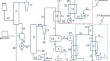
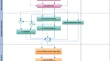
The base case is shown in Figure 1. The overall system consists of three subsystems with the following initial data and assumptions:

· LNG subsystem (process 1–2 − 3–4) - LNG from the storage system is (a) compressed by an LNG pump (P), (b) vaporized in heat exchanger II (HE II) using the waste heat from the nitrogen power system, and (c) expanded in expander III (EX III).

· N2 subsystem (process 11–12 − 13–14) - The N2 subsystem is a closed-cycle gas-turbine power system. After being cooled in HE II, the nitrogen is compressed in compressor III (CM III), heated in heat exchanger I (HE I) using the waste heat from an open gas-turbine power system, and expanded in expander II (EX II).

· Open gas-turbine power subsystem (process 21 through 28) - Air after compression in compressor I (CM I) is cooled in the cooler (CL) transferring thermal energy to the environment and is compressed in compressor II (CM II). After the combustion process in the combustion chamber (CC), the combustion gases are expanded in expander I (EX I) and rejected to the atmosphere after being cooled in HE I. The open gas-turbine power subsystem is based on an LMS 100 gas turbine (General Electric Company, Fairfield, CT, USA) [4].

thumbnailFigure 1. Schematic of the cogeneration system for vaporizing LNG

For the simulation and the exergetic analyses, the softwares GateCycle (General Electric Company, Fairfield, CT, USA) [5], Gatex (Institut für Energietechnik, Technische Universität Berlin, Germany) [6], and EES (F-Chart Software, LLC, Madison, WI, USA) [7] were used. Table 1 presents some results obtained from the simulation [3]. The following assumptions were used: ηCMI = 90%, ηCMII = 90%, p24/p21 = 42, T26 = 1,290°C, ηEX I = 94%, <a onClick="popup('http://www.journal-ijeee.com/content/3/1/1/mathml/M1','MathML',630,470);return false;" target="_blank" href="http://www.journal-ijeee.com/content/3/1/1/mathml/M1">View MathML</a>∆pHEI = 3%, ηCM III = 85%, p12/p11 = 15, ηEX II = 88%, <a onClick="popup('http://www.journal-ijeee.com/content/3/1/1/mathml/M2','MathML',630,470);return false;" target="_blank" href="http://www.journal-ijeee.com/content/3/1/1/mathml/M2">View MathML</a>∆pHEII = 3%, ηP = 66.5%, and ηEX III = 85%.

Table 1. Thermodynamic data for the material streams in the base case

Exergy-based analyses

Exergoeconomics is a unique combination of exergy analysis and cost analysis conducted at the component level to provide the designer or operator of an energy conversion system with information crucial to the design or operation of a cost-effective system. Decisions are made, however, at the plant component level [8,9]. A complete exergoeconomic analysis consists of (a) an exergetic analysis, (b) an economic analysis, and (c) an exergoeconomic evaluation.

An exergoenvironmental analysis is considered as one of the most promising tools to evaluate energy conversion processes from an environmental point of view [10]. Exergoenvironmental analysis is a proper combination of exergy analysis and life cycle assessment (LCA). The exergoenvironmental analysis consists of three steps: The first step is an exergy analysis. In the second step, an LCA of (a) each relevant system component and (b) all relevant input streams to the overall system is carried out. In the last step, the environmental impact obtained from the LCA is assigned to the exergy streams in the system.

Exergy analysis

Table 1 shows the value of exergy for each material stream. The chemical exergies for material streams of the N2 and the LNG subsystems do not need to be considered in the exergetic analysis because only the physical exergy of the working fluid is used in the corresponding subsystems. We considered the chemical exergies only in the open gas-turbine subsystem, where combustion takes place. The physical exergies of LNG, NG, and N2 are split into their thermal and mechanical parts according to the approach presented in [11].

The exergetic analysis has been conducted at the component level using the ‘exergy of the fuel’ and the ‘exergy of the product’ [8,9]. The definitions of <a onClick="popup('http://www.journal-ijeee.com/content/3/1/1/mathml/M4','MathML',630,470);return false;" target="_blank" href="http://www.journal-ijeee.com/content/3/1/1/mathml/M4">View MathML</a> and <a onClick="popup('http://www.journal-ijeee.com/content/3/1/1/mathml/M5','MathML',630,470);return false;" target="_blank" href="http://www.journal-ijeee.com/content/3/1/1/mathml/M5">View MathML</a> for each system component are given in [3]. Table 2 shows some data obtained from the conventional exergetic analysis.

Table 2. Results obtained from the conventional exergetic analysis[3]

Exergoeconomic analysis

The exergoeconomic model for an energy conversion system consists of cost balances written for the kth component and auxiliary equations based on the P and the F rules [8,9]. The cost balances can be written as

<a onClick="popup('http://www.journal-ijeee.com/content/3/1/1/mathml/M10','MathML',630,470);return false;" target="_blank" href="http://www.journal-ijeee.com/content/3/1/1/mathml/M10">View MathML</a>

(1)

or

<a onClick="popup('http://www.journal-ijeee.com/content/3/1/1/mathml/M11','MathML',630,470);return false;" target="_blank" href="http://www.journal-ijeee.com/content/3/1/1/mathml/M11">View MathML</a>

(2)

where

<a onClick="popup('http://www.journal-ijeee.com/content/3/1/1/mathml/M12','MathML',630,470);return false;" target="_blank" href="http://www.journal-ijeee.com/content/3/1/1/mathml/M12">View MathML</a>

(3)

To simplify the discussion, we assume that the contribution of <a onClick="popup('http://www.journal-ijeee.com/content/3/1/1/mathml/M13','MathML',630,470);return false;" target="_blank" href="http://www.journal-ijeee.com/content/3/1/1/mathml/M13">View MathML</a> remains constant when the design changes, and therefore, the changes in the value of <a onClick="popup('http://www.journal-ijeee.com/content/3/1/1/mathml/M14','MathML',630,470);return false;" target="_blank" href="http://www.journal-ijeee.com/content/3/1/1/mathml/M14">View MathML</a> are associated only with changes in the capital investment cost <a onClick="popup('http://www.journal-ijeee.com/content/3/1/1/mathml/M15','MathML',630,470);return false;" target="_blank" href="http://www.journal-ijeee.com/content/3/1/1/mathml/M15">View MathML</a>.

The real cost sources in an energy conversion system are the (a) capital investment (and operating maintenance expenses) for each component, (b) cost of exergy destruction within each component, and (c) cost of exergy loss from the overall system. The last two terms can be revealed only through an exergoeconomic analysis:

· The cost rate associated with exergy destruction within the kth component is

<a onClick="popup('http://www.journal-ijeee.com/content/3/1/1/mathml/M16','MathML',630,470);return false;" target="_blank" href="http://www.journal-ijeee.com/content/3/1/1/mathml/M16">View MathML</a>

(4)

· The cost rate associated with exergy loss from the overall system is

<a onClick="popup('http://www.journal-ijeee.com/content/3/1/1/mathml/M17','MathML',630,470);return false;" target="_blank" href="http://www.journal-ijeee.com/content/3/1/1/mathml/M17">View MathML</a>

(5)

The exergoeconomic model for the base case has been discussed in detail in [12]. Table 3 shows selected data obtained from the conventional exergoeconomic analysis. Here, the cooler is considered together with the cooling tower (<a onClick="popup('http://www.journal-ijeee.com/content/3/1/1/mathml/M18','MathML',630,470);return false;" target="_blank" href="http://www.journal-ijeee.com/content/3/1/1/mathml/M18">View MathML</a>), and the pump is considered together with the electrical motor (<a onClick="popup('http://www.journal-ijeee.com/content/3/1/1/mathml/M19','MathML',630,470);return false;" target="_blank" href="http://www.journal-ijeee.com/content/3/1/1/mathml/M19">View MathML</a>).

Table 3. Exergoeconomic variables for the LNG-based cogeneration systems

For the economic analysis, the methodology presented in [8] is applied using the following assumptions and sources:

· The purchased equipment cost of turbomachinery is based on data from [8,13].

· The purchased equipment cost of heat exchangers is based on data from [8].

· The cost of LNG is equal to $12/GJ [14].

· The average cost of money is ieff = 10%.

· The plant economic life is n = 15 years with 7,300 h/year.

· The average general inflation rate is rn = 2.5%

Exergoenvironmental analysis

Exergy analysis provides a powerful tool for assessing the quality of a resource as well as the location, magnitude, and causes of thermodynamic inefficiencies. In addition, LCA supplies the environmental impacts associated with a component or an overall system during its entire useful life. In the exergoenvironmental analysis, the environmental impacts obtained by LCA are apportioned to the exergy streams pointing out the main system components with the highest environmental impact and possible improvements associated with these components. Finally, exergoenvironmental variables are calculated, and an exergoenvironmental evaluation is carried out.

Life cycle assessment is a technique for assessing the environmental aspects associated with a product over its life cycle. The LCA process consists of goal definition and scoping (defining the system under consideration), inventory analysis (identifying and quantifying the consumption and release of materials), and interpretation (evaluation of the results) [15].

In general, any of recently introduced indicators can be used for LCA. For this exergoenvironmental analysis, an impact analysis method called Eco-indicator 99 [16] has been selected because it considers many environmental aspects and uses average European data.

In order to identify the raw material inlet flows, it is first necessary to perform a sizing of the plant components and to collect information about the weights, main materials, production processes, and scrap outputs of all relevant pieces of equipment needed to build the plant. This information is usually not very widely published (compared with the corresponding cost information). In this way, only rough calculations of the employed main materials and corresponding weights can be conducted.

The data collected in [17,18] were generalized in the form of equations (Tables 4 and 5) and used for estimating the component-related environmental impact that occurs during the construction phase. If the materials of a component correspond to the data given in Table 4, then the values of <a onClick="popup('http://www.journal-ijeee.com/content/3/1/1/mathml/M23','MathML',630,470);return false;" target="_blank" href="http://www.journal-ijeee.com/content/3/1/1/mathml/M23">View MathML</a> (relative environmental impact) and <a onClick="popup('http://www.journal-ijeee.com/content/3/1/1/mathml/M24','MathML',630,470);return false;" target="_blank" href="http://www.journal-ijeee.com/content/3/1/1/mathml/M24">View MathML</a> (relative mass) are equal to 1. If the selected material is different, then <a onClick="popup('http://www.journal-ijeee.com/content/3/1/1/mathml/M25','MathML',630,470);return false;" target="_blank" href="http://www.journal-ijeee.com/content/3/1/1/mathml/M25">View MathML</a> and <a onClick="popup('http://www.journal-ijeee.com/content/3/1/1/mathml/M26','MathML',630,470);return false;" target="_blank" href="http://www.journal-ijeee.com/content/3/1/1/mathml/M26">View MathML</a> (where ρ is the density of the material, kg/m3).

Table 4. Eco-indicator 99 values and material composition of components

Table 5. Environmental impact functions of components for the construction phase

For the LCA of the system being analyzed, we assumed in analogy with the economic analysis a life time of 15 years and 7,300 working hours per year at full capacity.

The exergoenvironmental model for an energy conversion system consists of environmental impact balances written for the kth component and auxiliary equations based on the P and F rules [10]. The environmental impact balances can be written as

<a onClick="popup('http://www.journal-ijeee.com/content/3/1/1/mathml/M39','MathML',630,470);return false;" target="_blank" href="http://www.journal-ijeee.com/content/3/1/1/mathml/M39">View MathML</a>

(6)

or

<a onClick="popup('http://www.journal-ijeee.com/content/3/1/1/mathml/M40','MathML',630,470);return false;" target="_blank" href="http://www.journal-ijeee.com/content/3/1/1/mathml/M40">View MathML</a>

(7)

where <a onClick="popup('http://www.journal-ijeee.com/content/3/1/1/mathml/M41','MathML',630,470);return false;" target="_blank" href="http://www.journal-ijeee.com/content/3/1/1/mathml/M41">View MathML</a> is the environmental impacts that occur during the three life-cycle phases: Construction <a onClick="popup('http://www.journal-ijeee.com/content/3/1/1/mathml/M42','MathML',630,470);return false;" target="_blank" href="http://www.journal-ijeee.com/content/3/1/1/mathml/M42">View MathML</a>, operation and maintenance, <a onClick="popup('http://www.journal-ijeee.com/content/3/1/1/mathml/M43','MathML',630,470);return false;" target="_blank" href="http://www.journal-ijeee.com/content/3/1/1/mathml/M43">View MathML</a>, and disposal <a onClick="popup('http://www.journal-ijeee.com/content/3/1/1/mathml/M44','MathML',630,470);return false;" target="_blank" href="http://www.journal-ijeee.com/content/3/1/1/mathml/M44">View MathML</a> constitute the component-related environmental impact associated with the kth component <a onClick="popup('http://www.journal-ijeee.com/content/3/1/1/mathml/M45','MathML',630,470);return false;" target="_blank" href="http://www.journal-ijeee.com/content/3/1/1/mathml/M45">View MathML</a>:

<a onClick="popup('http://www.journal-ijeee.com/content/3/1/1/mathml/M46','MathML',630,470);return false;" target="_blank" href="http://www.journal-ijeee.com/content/3/1/1/mathml/M46">View MathML</a>

(8)

To simplify the discussion, we assume in this paper that the value of <a onClick="popup('http://www.journal-ijeee.com/content/3/1/1/mathml/M47','MathML',630,470);return false;" target="_blank" href="http://www.journal-ijeee.com/content/3/1/1/mathml/M47">View MathML</a> is mainly associated with <a onClick="popup('http://www.journal-ijeee.com/content/3/1/1/mathml/M48','MathML',630,470);return false;" target="_blank" href="http://www.journal-ijeee.com/content/3/1/1/mathml/M48">View MathML</a>.

To account for pollutant formation within the kth component, a new variable was recently introduced <a onClick="popup('http://www.journal-ijeee.com/content/3/1/1/mathml/M49','MathML',630,470);return false;" target="_blank" href="http://www.journal-ijeee.com/content/3/1/1/mathml/M49">View MathML</a>[19,20]. This term <a onClick="popup('http://www.journal-ijeee.com/content/3/1/1/mathml/M50','MathML',630,470);return false;" target="_blank" href="http://www.journal-ijeee.com/content/3/1/1/mathml/M50">View MathML</a> is zero if no pollutants are formed within a process, i.e., for processes without a chemical reaction (compression, expansion, heat transfer, etc.). For components, where chemical reactions occur (combustion, for example), the value of <a onClick="popup('http://www.journal-ijeee.com/content/3/1/1/mathml/M51','MathML',630,470);return false;" target="_blank" href="http://www.journal-ijeee.com/content/3/1/1/mathml/M51">View MathML</a> is

<a onClick="popup('http://www.journal-ijeee.com/content/3/1/1/mathml/M52','MathML',630,470);return false;" target="_blank" href="http://www.journal-ijeee.com/content/3/1/1/mathml/M52">View MathML</a>

(9)

where only pollutant streams which will finally be emitted to the environment are taken into account: CO, CO2, CH4, N2O, NOx, and SOx[10].

The environmental impact of exergy destruction <a onClick="popup('http://www.journal-ijeee.com/content/3/1/1/mathml/M53','MathML',630,470);return false;" target="_blank" href="http://www.journal-ijeee.com/content/3/1/1/mathml/M53">View MathML</a> identifies the environmental impact due to the exergy destruction within the kth component [10]:

<a onClick="popup('http://www.journal-ijeee.com/content/3/1/1/mathml/M54','MathML',630,470);return false;" target="_blank" href="http://www.journal-ijeee.com/content/3/1/1/mathml/M54">View MathML</a>

(10)

To identify the most important components from the viewpoint of formation of environmental impacts, the sum of environmental impacts <a onClick="popup('http://www.journal-ijeee.com/content/3/1/1/mathml/M55','MathML',630,470);return false;" target="_blank" href="http://www.journal-ijeee.com/content/3/1/1/mathml/M55">View MathML</a> is used.

The detailed exergoenvironmental model for the LNG-based cogeneration system (Figure 1) will be presented in a future publication. In this paper, some data obtained from the conventional exergoenvironmental analysis are given in Table 6. Here, the cooler is considered together with the cooling tower (<a onClick="popup('http://www.journal-ijeee.com/content/3/1/1/mathml/M56','MathML',630,470);return false;" target="_blank" href="http://www.journal-ijeee.com/content/3/1/1/mathml/M56">View MathML</a>), and the pump is considered together with the electrical motor, <a onClick="popup('http://www.journal-ijeee.com/content/3/1/1/mathml/M57','MathML',630,470);return false;" target="_blank" href="http://www.journal-ijeee.com/content/3/1/1/mathml/M57">View MathML</a>.

Table 6. Exergoenvironmental variables for the LNG-based cogeneration systems

Advanced exergy-based analyses

The real potential for improving the system from a thermodynamic, economic, and environmental impact point of view can be estimated when the following are split into avoidable/unavoidable parts [17,21-23]:

· exergy destruction within each (important) system component,

· investment cost and environmental impact associated with such component, and

· cost of exergy destruction and environmental impact associated with the exergy destruction for each (important) system component.

The unavoidable exergy destruction cannot be further reduced due to technological limitations such as availability and cost of materials and manufacturing methods. The difference between total and unavoidable exergy destruction for a component is the avoidable exergy destruction. Only this value and not the total exergy destruction should be considered during the improvement procedure.

<a onClick="popup('http://www.journal-ijeee.com/content/3/1/1/mathml/M62','MathML',630,470);return false;" target="_blank" href="http://www.journal-ijeee.com/content/3/1/1/mathml/M62">View MathML</a>

(11)

The unavoidable investment cost (<a onClick="popup('http://www.journal-ijeee.com/content/3/1/1/mathml/M63','MathML',630,470);return false;" target="_blank" href="http://www.journal-ijeee.com/content/3/1/1/mathml/M63">View MathML</a>) and unavoidable component-related environmental impact (<a onClick="popup('http://www.journal-ijeee.com/content/3/1/1/mathml/M64','MathML',630,470);return false;" target="_blank" href="http://www.journal-ijeee.com/content/3/1/1/mathml/M64">View MathML</a>) for a component can be calculated by assuming the minimum values of <a onClick="popup('http://www.journal-ijeee.com/content/3/1/1/mathml/M65','MathML',630,470);return false;" target="_blank" href="http://www.journal-ijeee.com/content/3/1/1/mathml/M65">View MathML</a> and <a onClick="popup('http://www.journal-ijeee.com/content/3/1/1/mathml/M66','MathML',630,470);return false;" target="_blank" href="http://www.journal-ijeee.com/content/3/1/1/mathml/M66">View MathML</a>, respectively. These values will always be exceeded as long as such a component is used in a real system. The avoidable investment cost and component-related environmental impact are the differences between the total value and unavoidable part of this variable, i.e.,

<a onClick="popup('http://www.journal-ijeee.com/content/3/1/1/mathml/M67','MathML',630,470);return false;" target="_blank" href="http://www.journal-ijeee.com/content/3/1/1/mathml/M67">View MathML</a>

(12)

<a onClick="popup('http://www.journal-ijeee.com/content/3/1/1/mathml/M68','MathML',630,470);return false;" target="_blank" href="http://www.journal-ijeee.com/content/3/1/1/mathml/M68">View MathML</a>

(13)

The value of the unavoidable exergy destruction within the kth component is calculated using the ratio <a onClick="popup('http://www.journal-ijeee.com/content/3/1/1/mathml/M69','MathML',630,470);return false;" target="_blank" href="http://www.journal-ijeee.com/content/3/1/1/mathml/M69">View MathML</a> that refers to the case where only unavoidable exergy destruction occurs:

<a onClick="popup('http://www.journal-ijeee.com/content/3/1/1/mathml/M70','MathML',630,470);return false;" target="_blank" href="http://www.journal-ijeee.com/content/3/1/1/mathml/M70">View MathML</a>

(14)

The values of unavoidable capital investment cost and component-related environmental impact can be calculated using similar equations:

<a onClick="popup('http://www.journal-ijeee.com/content/3/1/1/mathml/M71','MathML',630,470);return false;" target="_blank" href="http://www.journal-ijeee.com/content/3/1/1/mathml/M71">View MathML</a>

(15)

<a onClick="popup('http://www.journal-ijeee.com/content/3/1/1/mathml/M72','MathML',630,470);return false;" target="_blank" href="http://www.journal-ijeee.com/content/3/1/1/mathml/M72">View MathML</a>

(16)

The approaches for estimating the values of <a onClick="popup('http://www.journal-ijeee.com/content/3/1/1/mathml/M73','MathML',630,470);return false;" target="_blank" href="http://www.journal-ijeee.com/content/3/1/1/mathml/M73">View MathML</a><a onClick="popup('http://www.journal-ijeee.com/content/3/1/1/mathml/M74','MathML',630,470);return false;" target="_blank" href="http://www.journal-ijeee.com/content/3/1/1/mathml/M74">View MathML</a>, and <a onClick="popup('http://www.journal-ijeee.com/content/3/1/1/mathml/M75','MathML',630,470);return false;" target="_blank" href="http://www.journal-ijeee.com/content/3/1/1/mathml/M75">View MathML</a> are given in [3,12].

Selected data obtained from the advanced exergy-based analyses for the LNG regasification system are given in Table 7. In this paper, we assumed that components of the open gas-turbine subsystem cannot be improved because this subsystem represents an already commercially available unit.

Table 7. Selected data obtained from the advanced exergy-based analyses

Results and discussion

Conventional exergy based analyses

The conclusions which can be obtained from the conventional exergetic analysis of the N2 and LNG subsystems are based on the values of <a onClick="popup('http://www.journal-ijeee.com/content/3/1/1/mathml/M91','MathML',630,470);return false;" target="_blank" href="http://www.journal-ijeee.com/content/3/1/1/mathml/M91">View MathML</a> (Table 2). The components with the highest potential for improvement are EX II, CM III, and HE II.

The economic analysis (value <a onClick="popup('http://www.journal-ijeee.com/content/3/1/1/mathml/M92','MathML',630,470);return false;" target="_blank" href="http://www.journal-ijeee.com/content/3/1/1/mathml/M92">View MathML</a> in Table 3) shows that EX II is the most expensive component among the N2 and LNG subsystems followed by HE I and CM III.

The results from the exergoeconomic analysis (values of <a onClick="popup('http://www.journal-ijeee.com/content/3/1/1/mathml/M93','MathML',630,470);return false;" target="_blank" href="http://www.journal-ijeee.com/content/3/1/1/mathml/M93">View MathML</a> in Table 3) show that EX II and CM III are by far the most important components from the economic viewpoint and that the high costs (<a onClick="popup('http://www.journal-ijeee.com/content/3/1/1/mathml/M94','MathML',630,470);return false;" target="_blank" href="http://www.journal-ijeee.com/content/3/1/1/mathml/M94">View MathML</a>) for these components are caused primarily by the exergy destruction (<a onClick="popup('http://www.journal-ijeee.com/content/3/1/1/mathml/M95','MathML',630,470);return false;" target="_blank" href="http://www.journal-ijeee.com/content/3/1/1/mathml/M95">View MathML</a>). This demonstrates (a) the importance of the N2 subsystem for the economics of the overall system and (b) the necessity to keep the thermodynamic inefficiencies occurring within the N2 subsystems to a minimum.

The results obtained from the LCA (value <a onClick="popup('http://www.journal-ijeee.com/content/3/1/1/mathml/M96','MathML',630,470);return false;" target="_blank" href="http://www.journal-ijeee.com/content/3/1/1/mathml/M96">View MathML</a> in Table 6) demonstrate that the component-related environmental impact associated with HE I and HE II is the highest among all components of the overall system.

The exergoenvironmental analysis (value <a onClick="popup('http://www.journal-ijeee.com/content/3/1/1/mathml/M97','MathML',630,470);return false;" target="_blank" href="http://www.journal-ijeee.com/content/3/1/1/mathml/M97">View MathML</a> in Table 6) shows that for all components, the environmental impact associated with the exergy destruction is much higher than the component-related environmental impact (<a onClick="popup('http://www.journal-ijeee.com/content/3/1/1/mathml/M98','MathML',630,470);return false;" target="_blank" href="http://www.journal-ijeee.com/content/3/1/1/mathml/M98">View MathML</a>+<a onClick="popup('http://www.journal-ijeee.com/content/3/1/1/mathml/M99','MathML',630,470);return false;" target="_blank" href="http://www.journal-ijeee.com/content/3/1/1/mathml/M99">View MathML</a>). Only for the pump and EX III are these values comparable. Based on the sum (<a onClick="popup('http://www.journal-ijeee.com/content/3/1/1/mathml/M100','MathML',630,470);return false;" target="_blank" href="http://www.journal-ijeee.com/content/3/1/1/mathml/M100">View MathML</a>), the most important components are again EX II and CM III. They can be improved by decreasing the exergy destruction and, therefore, decreasing the environmental impact associated with the exergy destruction.

The conventional exergy-based analyses suggest to initially decrease the exergy destruction within the N2 subsystem and mainly within EX II and CM III. This decrease of exergy destruction will not only increase the overall efficiency, but will also simultaneously reduce both costs and environmental impact associated with the overall system.

Advanced exergy-based analyses

The advanced exergy-based analyses (results shown in Table 7) refine and correct the results from the conventional analyses. From the thermodynamic point of view, for example, CM III does not have the importance that the conventional exergetic analysis suggests because most of the exergy destruction in CM III is unavoidable. HE II and P are thermodynamically more important than CM III when only avoidable exergy destruction within each component is considered. Thus, improvement efforts should focus more on EX II, HE II, and P (where the potential for improvement is higher) than in CM III.

However, from the cost viewpoint, CM III is much more important than HE II or P because the cost per unit of exergy supplied to the compressor (cost of fuel) has the highest value among all components (see cF,k values in Table 3). The highest potential for reducing the cost of the overall product is still associated with EX II and CM III that exhibit the highest value of <a onClick="popup('http://www.journal-ijeee.com/content/3/1/1/mathml/M101','MathML',630,470);return false;" target="_blank" href="http://www.journal-ijeee.com/content/3/1/1/mathml/M101">View MathML</a>.

The values of <a onClick="popup('http://www.journal-ijeee.com/content/3/1/1/mathml/M102','MathML',630,470);return false;" target="_blank" href="http://www.journal-ijeee.com/content/3/1/1/mathml/M102">View MathML</a> indicate that the highest potential for reducing the overall environmental impact is associated with EX II, CM III, and HE I. Thus, the advanced exergoenvironmental analysis emphasizes the importance of component HE I compared with the conventional exergoenvironmental analysis.

The advanced analyses confirm the conclusion from the conventional analyses that by decreasing the exergy destruction within the N2 subsystem, the efficiency of the overall system would increase while the cost and the environmental impacts would decrease.

Conclusions

The present work identified the importance of the N2 subsystem in improving the overall system and demonstrated the advantages of splitting thermodynamic inefficiencies, cost, and environmental impacts into unavoidable and avoidable parts.

Results show that efforts should focus on EXII, HEII, and P in order to improve the thermodynamic efficiency and reduce the environmental impact. To improve the cost effectiveness, effort should focus on EXII and CMIII. Thus, EX II is the most important system component regardless of the viewpoint of the analyst.

Even more accurate information is obtained when these variables are split into their endogenous and exogenous parts because, then, the interactions among components become transparent. The results from complete advanced exergy-based analyses will be presented in subsequent publications.

Nomenclature

b specific environmental impact per unit of exergy (Pts/J) or per unit of mass (Pts/kg)

<a onClick="popup('http://www.journal-ijeee.com/content/3/1/1/mathml/M103','MathML',630,470);return false;" target="_blank" href="http://www.journal-ijeee.com/content/3/1/1/mathml/M103">View MathML</a> environmental impact rate associated with exergy (Pts/s)

C cost associated with an exergy stream ($)

c cost per unit of exergy ($/J)

<a onClick="popup('http://www.journal-ijeee.com/content/3/1/1/mathml/M104','MathML',630,470);return false;" target="_blank" href="http://www.journal-ijeee.com/content/3/1/1/mathml/M104">View MathML</a> exergy rate (J)

e specific exergy (J/kg)

kkth component

<a onClick="popup('http://www.journal-ijeee.com/content/3/1/1/mathml/M105','MathML',630,470);return false;" target="_blank" href="http://www.journal-ijeee.com/content/3/1/1/mathml/M105">View MathML</a> mass flow rate (kg/s)

p pressure (Pa)

<a onClick="popup('http://www.journal-ijeee.com/content/3/1/1/mathml/M106','MathML',630,470);return false;" target="_blank" href="http://www.journal-ijeee.com/content/3/1/1/mathml/M106">View MathML</a> heat rate (W)

T temperature (K)

<a onClick="popup('http://www.journal-ijeee.com/content/3/1/1/mathml/M107','MathML',630,470);return false;" target="_blank" href="http://www.journal-ijeee.com/content/3/1/1/mathml/M107">View MathML</a> power (W)

<a onClick="popup('http://www.journal-ijeee.com/content/3/1/1/mathml/M108','MathML',630,470);return false;" target="_blank" href="http://www.journal-ijeee.com/content/3/1/1/mathml/M108">View MathML</a> component-related environmental impact rate (Pts/s)

<a onClick="popup('http://www.journal-ijeee.com/content/3/1/1/mathml/M109','MathML',630,470);return false;" target="_blank" href="http://www.journal-ijeee.com/content/3/1/1/mathml/M109">View MathML</a> cost rate associated with investment expenditures ($)

Greek symbols

ε exergetic efficiency (%)

η isentropic efficiency (%)

Superscripts

AV avoidable

CH chemical

CT cooling tower

M mechanical

PF pollutant formation

PH physical

T thermal

UN unavoidable

Subscripts

PI cast iron

CON concrete

D exergy destruction

F exergy of fuel

k kth component

L exergy loss

P exergy of product

PVC polyvinylchlorid

S steel

SHA high alloy steel

SLA low alloy steel

tot overall system

0 thermodynamic environment (reference state)

Abbreviations

CC = Combustion chamber; CL = Cooler; CM = Compressor; CT = Cooling tower; EM = Electrical motor; EX = Expander; HE = Heat exchanger; P = Pump.

Competing interests

The authors declare that they have no competing interests.

Authors' contributions

TM co-supervised the work, conducted the exergy analysis, and drafted the manuscript. GT co-supervised the work, conducted the economic analysis, and corrected the manuscript. AB conducted the life cycle assessment. CG conducted the calculations according to the instructions provided by the supervisors. All authors read and approved the final manuscript.

Authors' information

Professor TM is employed at the Technische Universität Berlin. She studied refrigeration engineering at the Odessa State Academy of Refrigeration, Ukraine and received her diploma in 1990. She received her Ph.D. in 1994 and professorship in 2001, all in Ukraine. Her field of interest is the application of modern exergy-based methods to the analysis and improvement of power plants and refrigeration systems. She is the author or co-author of six books and more than 200 publications and has 10 patents.

GT is the Bewag Professor of Energy Conversion and Protection of the Environment at Technische Universität Berlin. He received a diploma in Mechanical Engineering (NTU Athens, Greece), and his MBA, Ph.D. in Combustion, and Dr. Habilitatus Degree in Thermoeconomics, all from the RWTH Aachen, Germany. His areas of interest include the design, development, analysis, and optimization of energy conversion systems. He contributed significantly to the fundamentals of exergoeconomics, a term that he coined in 1984. He co-authored the book Thermal Design and Optimisation (Wiley, 1996), has published more than 270 papers, received several international awards and recognitions, and has served as chairman or co-chairman of 20 international conferences.

AB received her Ph.D. in Chemical Engineering and Environmental Technologies in the University of Zaragoza (Spain). Since 2010, she is a researcher in the Joint Research Centre of Institute of Prospective Technological Studies of the European Commission in the area of sustainability. She gained experiences with the exergoeconomic and exergoenvironmetal analyses in Technische Universität Berlin (post-doc during the years 2008 to 2009). She is a co-author of more than 40 papers published in the International Journals and Proceedings of the International conferences.

CG is a Chemical Engineer (2004, Universidad Nacional de Colombia) and M.Sc. in Process Energy Environmental Systems Engineering (2011 - Technische Universität Berlin, Germany).

Acknowledgments

The authors would like to thank Professor Hartmut Griepentrog (Greif-Foundation, Gelsenkirchen, Germany) for developing the base case and for many helpful discussions regarding gas-turbine power systems and LNG vaporization.

References

  1. Griepentrog, H, Tsatsaronis, G, Morosuk, T: A novel concept for generating electricity and vaporizing LNG. In: Ziebik A, Kolenda Z, Stanek W (eds.) Proceedings of the 21th International Conference on Efficiency, Cost, Optimization, Simulation and Environmental Impact of Energy Systems, Cracow-Gliwice, (2008)

  2. Griepentrog, H, Tsatsaronis, G, Morosuk, T: LNG vaporization using a novel co-generation system. Proceedings of the ASME International Mechanical Engineering Congress and Exposition, Boston (2008)

  3. Tsatsaronis, G, Morosuk, T: Advanced exergetic analysis of a novel system for generating electricity and vaporizing liquefied natural gas. Energy. 35, 820–829 (2010). Publisher Full Text OpenURL

  4. Reale, MJ. New high efficiency simple cycle gas turbine – GE's LMS100™, General Electric Company, USA. [http://www.ge.com] webcite (2004). Accessed 26 February 2007

  5. GateCycle for Windows, Version 5.52.0.r: The General Electric Company, 1989–2004 [http://www.gepower.com/enter] webcite

    Accessed 1 March 2007

    PubMed Abstract | Publisher Full Text OpenURL

    Accessed 1 March 2007

  6. Gatex (Technische Universität Berlin, Institut für Energietechnik), 2002. Ref: Eisermann W, Hasberg W, Tsatsaronis G. THESIS - Ein Rechenprogramm zur Simulation und Entwicklung von Energieumwandlungsanlagen. Brennst.-Wärme-Kraft. 36(1–2):45–51 (1984)

  7. EES (Engineering Equation Solver), 1992-2010, V7.847, #92: McGraw-Hill [http://www.fchart.com] webcite Accessed 01 September 2011

  8. Bejan, A, Tsatsaronis, G, Moran, M: Thermal Design and Optimization, Wiley, New York (1996)

  9. Lazzaretto, A, Tsatsaronis, G: SPECO: a systematic and general methodology for calculating efficiencies and costs in thermal systems. Energy. 31(8–9), 1257–1289 (2006)

  10. Meyer, L, Tsatsaronis, G, Buchgeister, J, Schebek, L: Exergoenvironmental analysis for evaluation of the environmental impact of energy conversion systems. Energy Int J. 34, 75–89 (2009)

  11. Morosuk, T, Tsatsaronis, G: Graphical models for splitting physical exergy. In: Kjelstrup S, Hustad JE, Gundersen T, Rosjorde A, Tsatsaronis G (eds.) Shaping Our Future Energy Systems, pp. 377–384. Tapir academic press, Trondheim (2005)

  12. Tsatsaronis, G, Morosuk, T, Cziesla, F: LNG-based cogeneration systems. Part 2. Advanced exergy-based analyses of a concept. Paper presented at the ASME 2009 International Mechanical Engineering Congress & Exposition (IMECE2009), Lake Buena Vista, Florida (2009) 13–19 November, IMECE2009-10460

  13. Pequot: Gas Turbine World Handbook, Southport (2006)

  14. US Department of Energy [http://www.eia.doe.gov] webcite Accessed 01 September 2011

  15. International Organization for Standardization (ISO): Environmental management—life cycle assessment. European Standard ENISO14040 and 14044, Geneva (2006).

  16. Goedkoop, M, Spriensma, R. The Eco-indicator 99: a damage oriented method for life cycle impact assessment. Methodology Report, Amersfoort, Netherlands. [http://www.pre.nl] webcite (2000). Accessed 06 August 2007

  17. Tsatsaronis, G, Morosuk, T: A general exergy-based method for combining a cost analysis with an environmental impact analysis. Part II—application to a cogeneration system. In: Proceedings of the ASME International Mechanical Engineering Congress and Exposition, Boston (2008) 31 October–6 November, IMECE2008-67219

  18. Cabrera, M: Exergoenvironmental analysis of oxyfuel-based combined-cycle power plants including CO2 capture. Master Thesis, Technische Universität Berlin (2010)

  19. Boyano, A, Blanco-Marigorta, AM, Morosuk, T, Tsatsaronis, G: Exergoenvironmental analysis of a steam methane reforming process for hydrogen production. Energy Int J (2010)

  20. Petrakopoulou, F: Comparative evaluation of power plants with CO2 capture: thermodynamic, economic and environmental performance. Ph.D. Dissertation, Technische Universität, Berlin (2010)

  21. Tsatsaronis, G, Morosuk, T: A general exergy-based method for combining a cost analysis with an environmental impact analysis. Part I–theoretical development. In: Proceedings of the ASME International Mechanical Engineering Congress and Exposition, Boston (2008) 31 October–6 November, IMECE2008-67218

  22. Tsatsaronis, G, Park, MH: On avoidable and unavoidable exergy destructions and investment costs in thermal systems. Energy Convers Manage. 43, 1259–1270 (2002). Publisher Full Text OpenURL

  23. Cziesla, F, Tsatsaronis, G, Gao, Z: Avoidable thermodynamic inefficiencies and costs in an externally fired combined cycle power plant. Energy Int J. 31(10–11), 1472–1489 (2006)